Posted on

Protect your Home

Protect your home from aging

Protect your home from the elements, and it will never age. This can be accomplished by sealing the exterior materials. Thankfully, the interior of your home isn’t exposed to weather; just wear and tear. To upgrade it, we paint or stain. We replace old appliances with new. Upgrading the exterior facade isn’t quite so easy, and is very costly

Few people realize it, but the exterior materials can be protected from weather simply by spraying it with a good sealant. Siding, be it wood or vinyl can be sealed. Roofing, no matter the material, can be sealed. Concrete porches, or walks, concrete, or asphalt driveways, wooden decks, brick or stone walls. No matter what materials or products your home is constructed with, it can last more than a lifetime if it’s sealed

Your home can last a lifetime

There are several good all purpose sealants on the market today. Do it yourself, or hire a handy man, but if you choose the latter, make sure you have insurance to cover accidents

Depending on your location, and the product you choose, your home will need to be sealed once a year, to every five years

Consider a Custom home design

All rights reserved
Author: Brenda Rand


Posted on

Passive Cooling System

Passive cooling system is the best kept secrete

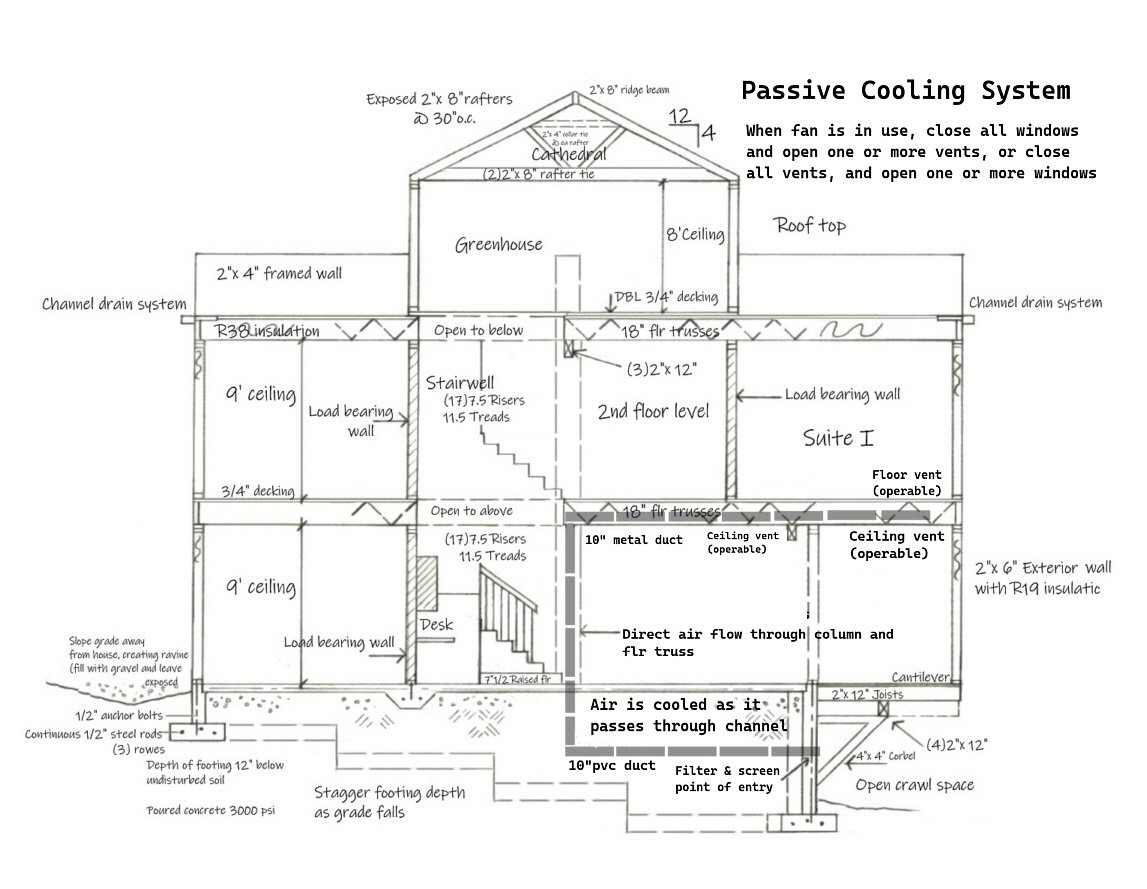
Passive cooling system provides a low cost means of keeping cool in the summer. Affordable to operate, it’s also reasonably simple to install. Some people use this method exclusively to cool their homes.

Include it in the plans for your new home, or add it on to your older home. The ductwork (approximately 10″ dia) is buried three to five feet beneath the earth, depending on the weather in your location. The hotter the summers; the deeper the the channels

Solar powered cooling system

The ducts can be a part of your standard heat and air ductwork, or separate, however, the layout is the same, with vents located against the walls in the rooms you want to cool. Locate the vents in the floor or ceiling

Point of entry should be filtered, and easy to access. Vents should be operable, as well as the point of entry, or capped to close keep cold air from entering the channel in colder seasons

An electric powered, or solar powered fan is used for pulling air into and through the house

Consider a Custom home design

All rights reserved
Author: Brenda Rand


Posted on

Organic by Design

fantastic house plan

Organic by design, the home you live in

Organic by design? Why not? It’s not easy to create an organic environment in our homes, but if you appreciate eating foods free of additives, why not opt for living in an all natural house?

Most materials being used in today’s homes are synthetics; man made, but just a few decades ago, our homes were built from all natural materials, such as wood, stone, brick or stucco. These natural materials cost quite a bit more, so you’ll either have to compromise on square footage, or style if you’re on a budget. Homes with steep roofs that have reverse gables, or raised plate lines are pretty, but expensive. Homes with low pitches, and few exterior corners are cheap by comparison

Synthetic are all too often labeled as ‘virtually’ fireproof, but when they do burn, the fumes are deadly. These man made materials cannot compete with the bold look of authentic materials

Build a home that is people friendly; a home that lets the sunshine in; a home filled with fresh air; with water rich in mineral value. The filtering systems in our homes are good for the plumbing, but bad for our health. Stripped of value, pure water is less than desirable, because without minerals, we cannot live. Responsible for alkalinity, carbonate mineral (KH) gives water, and our blood as well, the ability to support oxygen. Healthy blood is heavily oxygenated. Without this mineral there would be no life in our natural bodies of water; no life on earth. Other important minerals are magnesium and calcium (GH) both equally important to our health. Water your plants with filtered tap water, and you’ll need to supply the missing minerals, or the plants will wither away. The same is true of humans and animals. We all must have these vital minerals, and water is the best way to get them

You’ve heard that sunshine gives you vitamin D, but it does much more. The ultraviolet (UVB) rays aid in calcium production, strengthening bones. We call it the sunshine vitamin. Sunlight increases serotonin levels in the brain, preventing depression, and seasonal mood disorders. Imagine all of the people taking harmful drugs to lessen depression, when all they really need is to get outside and get some sun, which increases serotonin levels in the brain. Moderate exposure to sun helps regulate the immune system, triggering the release of nitric oxide, lowering blood pressure. The best time to sun is in morning. The morning sunlight regulates our circadian rhythm, and if when you turn all the lights off at night, you’ll sleep well. We’ve been told that the sun causes cancer, and to either stay indoors, or use a sun block, loaded with dangerous chemicals. Have they been making us sick so they can get rich healing us?

A home properly oriented to solar exposure should allow plenty of natural light, while protecting you from the harsh afternoon sun

Houses today are overly insulated, which of course reduces energy use, but just how healthy are these homes to live in. Back in the old days, homes could breathe, because they had little insulation. This means air, cold or warm, seeped into the house, uninvited. We sat around the fireplace or the wood burner to keep warm. Today, this sounds archaic, but it was very healthy. Homes were filled with fresh air, and the fires that warmed us provided infra red light; which we’ve discovered has many health benefits. Today most of our homes are heated with electric, or gas. If there is a flame, it’s hidden inside of the furnace, with forced air keeping us warm in every nook and cranny of the house. Most of us sit around watching tv in the evenings, yawning, and falling asleep. This is due to the Co2 (carbon dioxide) in your home; recycled air. Crack a window, or open a door periodically to let the fresh air in. If you’re planning on building a new home, be sure to include a wood burner, or a fireplace. You’ll not only reap the health benefits, but you’ll also stay warm in a power outage

Some of us are lucky enough to have swimming pools in our back yards, and while adults and children alike greatly enjoy the activity, the chemicals we use to keep the water free of bad bacteria may be just as dangerous as the germs they kill. Is it possible to swim safely in a pool without these chemicals? If you’ve ever swam in a river or lake, you’ll agree it is possible. Have you ever heard of the nitrogen cycle? This omnipotent event is happening quietly, behind the scene in every ocean, lake, river and creek. The critters that live in the waters make waste. From waste, ammonia forms. Ammonia is toxic to any creature exposed to it, but it’s also a food source for beneficial bacteria. They form naturally, to feed on toxin, and then convert it into nitrites, the second toxin to form in the nitrogen cycle. Nitrites is deadly to animal life. When nitrites are present, another type of friendly bug appears magically, consuming the toxin, converting it into nitrates, the third and final toxin in the nitrogen cycle. Nitrates are deadly, but only in high amounts. Thankfully, nitrates are a food source for algae, the end result of the nitrogen cycle. All plants feed on nitrates, and most of them, like algae, are a food source for fish. The fish consume the plants, and then produce waste, completing the circle of life

If you were to test ammonia, nitrites and nitrates in a healthy, natural body of water, you would find a reading of zero for all three toxins. Thanks to Mother Nature, we can enjoy a swim with no worries of infection, as bad bacteria dies instantly when coming into contact with good bacteria. Oxygen also plays an important role in creating a safe environment. Oxygen also kills bad bugs on contact. Water is oxygenated by method of diffusion. This occurs when waves pull Co2 (gas created from waste) from the body of water, freeing it. At the same time, O2 is pulled into the body of water. If the water is rich in alkalinity, it will support the oxygen molecule. Carbonate mineral is responsible for alkalinity, and if your tap water isn’t filtered, it should have a proper pH. Potential of hydrogen, pH is a measurement of how base or acidic water is, with a reading of 6.ppm being acidic, and considered as to low in pH value to support life. A pH reading of 7.ppm is neutral, whereas a reading of 8.ppm would be considered a healthy alkalinity

It all may seem complicated, but at the same time, it’s all quite fascinating; Mother Nature

Posted on

The Power of Nature

The power of nature is greater than any other power. We acknowledge the harm it can do, but we sometimes overlook the good

Over the years, in an effort to improve the housing market by lowering construction costs, building products have become more and more synthetic; unnatural. We’ve become desensitized to the fact. It’s normal to see vinyl siding, and faux stone, even though most of these materials have a low fire rating, and a low R value. Few are eco-friendly. The average home being built today is somewhat energy efficient, conserving power with the use of high grade insulation, but how do these homes affect our health?

Most of us think nothing of our surroundings, and assume we are safe. We leave it up to government organizations put in place just for these purposes. Our food is supposedly protected by the Food and Drug administration. Environmental Protection Agency, and Agency for Toxic Substances and Disease Registry are also here to help. A few non profits that supposedly keep us safer, are Earth Justice, Environmental Working Group, Toxic Free Future and Safer States. Still, with all of these organizations working tirelessly for us, we face dangers and health risk everywhere, every day, with cancer at an all time high

Don’t panic. Instead, do your best to keep your world chemical free, and then relax and enjoy life. The medical experts say, worrying causes stress, and stress causes more illness than any of the chemicals we fight in our every day life, but still, it’s important to do everything we can to lessen the threat. Does that mean we should give up our wifi? We used to enjoy internet via cable, but we’ve become a spoiled people, and demand an instant signal wherever we go, and this means filling the air with waves, or non-ionizing radiation, much like a radio frequency of electromagnetic fields. These fields lack the energy to break chemical bonds or damage DNA directly, or so we’re told. We’re also warned not to hold our cell phones up to our heads due to the risk of cancerous tumors. Confusing isn’t it.

Harmful to humans, and harmful to the environment

The list of health risks goes on. For example, the use of LED lighting is not only encouraged by the industry, as they save a great deal of energy. It’s difficult to find incandescent light bulbs these days. Others say LED lighting poses health risks through blue light emission, and harsh glare. Some say they create an invisible flicker that may trigger headaches and cause eye strain, or even disrupt sleep. LEDs can trick your brain into thinking it’s daytime, which suppresses the production of melatonin, disrupting the circadian rhythm, which greatly impacts our health.

Experts claim the electric wiring in our walls emits a low frequency (ELF) non-ionizing radiation, an invisible electromagnetic field, or EMFs, posing a health risk. Placing the wiring in PVC channels greatly reduce these emissions, however, most builders won’t go to this added expense without the home owners insistence, and few home owners are aware of the risk

What price do we put on our health?

The fact is, the standard homes being built today are toxic to live in; from floor to ceiling, the interior products used are laced with chemicals that slowly leach poison into the air we breath. Carpet fibers like nylon and polyester, backing adhesives, and synthetic latex binders not only emit gases, but transfer on to the skin of our pets and children. Isn’t it interesting that we stopped adding lead to paint, because it was bad for us. We stopped using asbestos after learning it caused cancer, however many of the products we use today cause the same serious healthy issues.

Are we in denial?

Spray foam insulation releases vapors containing methylene, diphenyl and disocyanate (MDI) during installation, which can trigger asthma or lung irritation. They safe it’s safe after it dries, but where do these fumes end up? Where do they land? Modern fiberglass is non-toxic and often formaldehyde-free. It is safe in your walls, but handling raw batts can cause skin, eye, and lung irritation if you do not wear protective gear. When commonly placed in open attics that are also used for storage, we’re putting our health at risk every time we enter that space. Made from recycled paper products and treated with fire retardants, cellulose is safe inside closed cavities. However, it readily absorbs moisture, leading to mold.

Have we accepted poor health as a fact of life?

Is it possible to build an organic home in this day and age? Yes, however, the cost per square foot is quite a bit higher. It starts by demanding authentic materials; real wood, real brick and stone outside, and real wood, tile or stone flooring inside. Homes designed and built that function with minimal impact on the environment cost more to build, but some new home owners are willing to make the compromise. The same home that is organic, and safe to live in, typically employs methods of collecting rain water and energy as well. Low flow fixtures are utilized. Eco-friendly materials are non toxic, recycled, or locally sourced, or recycled products. There are many things we can do to save our health, and at the same time, save the environment.

Throughout history, man has used moving wind and water to generate power, although, these methods are somewhat uncommon in generating power for homes today. They are mainly used in commercial applications. Solar however, has become adaptable for industry, small commercial and even residential.

Solar map

Solar Zones Explained - Solar EducationA well designed home is placed on the site precisely, utilizing solar orientation to assist in temperature control with less mechanical heating and cooling. Combine orientation with a good passive cooling system, and you have a home that’s filled with fresh air, instead of air that’s been recycled over and over again. Natural cooling pulls air via a solar powered fan from outdoors, and beneath the grade to cool it, before releasing it into the living space. What energy is needed may be supplied by well placed solar panels, and if the home owner is located in a sunny location, the energy savings can be substantial. The map below shows the five solar zones in the US. If you’re located in 1, forget solar. If you’re in zone  5, you could actually collect more energy than you use.


Organic by nature, homes constructed from all natural materials offer an alternative from the standard homes being built today. There are products that are safe for us and the ecosystem; products that do not offend, but there are also products that actually help us feel better. Physical and mental health can be greatly improved by using them. We’ve learned from science that our well being may depend on how much natural sunlight we get, and by breathing fresh air. Colors and materials effect our mood with green being at the top of the list, especially the green born from chlorophyll; from real vegetation. Indoor water features create negative ions, which make us feel happy,  and joy brings good mental health, which leads to physical health.

Mother Nature can heal the sick

Copper, and organic metal, has thermal conductivity. It absorbs heat rapidly and redistributes it evenly, keeping water warmer for longer periods of time. This prolonged warmth effectively relieves joint stiffness, calms sore muscles, and lowers blood pressure. Our skin absorbs safe amounts of copper ions while soaking, which helps to restore tissue, and reduce inflammation in joints. It stimulates collagen production and elasticity. Soaking in a copper tub has also proven to relieve stress, and improve quality of sleep.

Living in these types of homes may help us live longer, healthier and happier lives.

Consider a custom house plan
Posted on

Yocum s Bay

Yocum’s Bay fishing and living retreat

The road leading into our prospective development is called Yocum. The name has some historical value to the region, unbeknownst to most people. In the early eighteen hundreds, the Yocum brothers settled in Taney county. One brother traded some goods to the Delaware Indians for a silver mine, hidden in the hills. Eventually, the brothers began minting coins. These coins became popular, and circulated throughout the territory. The federal government got wind, and the brothers ran in separate directions to avoid capture. In time the mine was forgotten; its location lost forever, except for the stories left behind

  • Bull Shoals reservoir
    Stocked with a variety of fish that can’t be found in other local lakes combined, such as spotted bass, walleye, large mouth bass, small mouth bass and white crappie, Bull Shoal is every fisherman’s dream. Thirty wooded acres of lake front property will become speckled with cabins for nature lovers that live to fish.
  • Shanty house plan
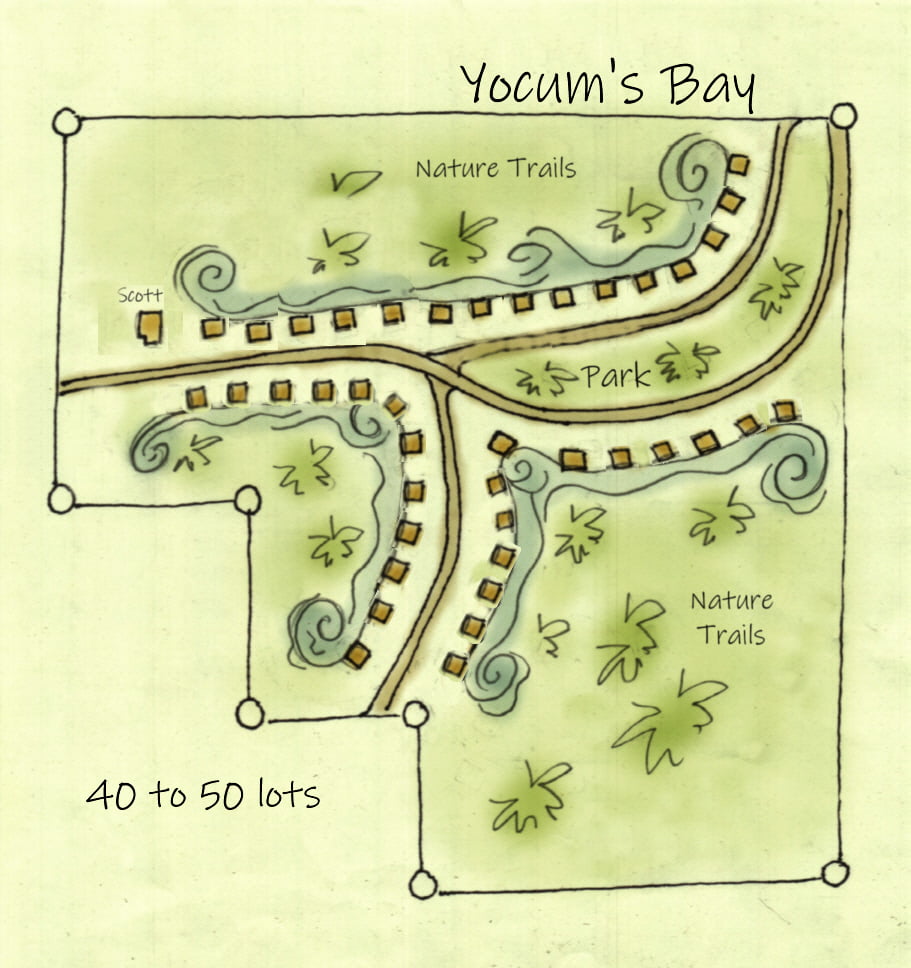
    Building up, not out, will not only save precious land and keep building cost low, but will also offer a scenic view from the roof top patios. Real wood and metal exterior finish materials, combined with the no frills exterior styling, lives up to the fisherman’s reputation of being rugged and tough, but genuine. Step inside to modern conveniences and comfort that include options for gas log or wood burning fireplaces, with one, two, or even three-bedroom suite floor plans to choose from.The site has yet to be surveyed, and the land plan we’ve created is only a rough draft, however, the concept remains the same. The grade elevations will dictate the location of the stream. We hope it’s possible to have one continuous stream, however, it may be necessary to break the stream into three sections, as shown on the land plan. A minimum of forty homes will line the roads cutting through the acreage, but our goal will be to make it fifty. Home sizes range from 1400 SF to 2800 SF.
  • Amenities
    Man-made streams will cozy up to the homes, with rear decks hanging over the water’s edge, making life a little easier for the lazy fisherman. Being bottom feeders, catfish will be safe from predators in the shallow streams, keep the water free of algae, and provide some good eating as well. A small park with a few boulders to climb will make a great spot for the kids to play. Scatter a few picnic tables, and we also have a place for families and neighbors to gather. Nature trails will wind in and around the trees, opening up to small clearings that invite a variety of wildlife to frequent.
  • HOA
    Yocum’s Bay home owners association will be established soon after construction begins. A cooperative of sorts, the homeowners will share ownership of the common grounds and shop, as well as the responsibility. One of the units will be modified as a shop with an apartment above for our shop keeper who will live on site. The shop will be located at the entrance, offering a wide variety of supplies, groceries and even kayaks to rent. The profit made from this shop will offset the cost to maintain the property, taking a good portion of the load off the homeowners.
  • Lot description
    Lots sized at 1/10 of an acre, or approximately 56′ (width) by 78′ (length) starting at the road, and ending at the stream) with 10′ on each side of house for additional parking. Staggered placement of the lots, with a minimum of one lot size of common, wooded ground in between will offer each home a measure of privacy. Lots will be cleared as they are sold, with the fee charged to the buyer. Roughly five acres of trees for the entire project will be removed.  Completely cleared of trees, with mostly pervious substrate, such as river rock, the individual lots offer low maintenance yards that are harmonious with nature. Homeowners will be responsible for maintaining their own lots. In the event individual septic tanks are denied by the county, our streams will double as a lagoon.
  • Buyer’s restrictions
    Buyers are restricted to using our home design and our builder, however, the shanty plan’s options will please the masses. Homes could be used for corporate vacations, short term lease investments or individual ownership, with our shop keeper available for registering guests, managing cleaning service and Kayak rental.
  • Advertising and promotions
  • Design and planning fees.….$7,500 to start (includes cost of rough land planning, Shanty home design and permit ready construction documents for one standard three bedroom unit plus shop with apartment above
    $1,500 per home sold (includes permit ready construction documents)
  • Sales

  • Project management